

New to reviewing? This is the process every review here follows. Keep the Review Desk open in another tab and work through it as you taste. Nothing you type in the desk leaves your browser. Rather taste with a pen? Print the Basic or Advanced tasting sheet and type it up later.
Rather write somewhere else? Grab the blank review template (.md), fill it in with any text editor or notes app, then bring it back with Open .md file in the desk.
- 1Set upA Glencairn or tulip glass, about an ounce, and a few minutes. Let it rest in the glass while you jot down the bottle details.
- 2Taste in orderLook first, then work through nose, palate, finish, with water. Pick flavors on the wheel as they show up, and add your own words.
- 3Make the callScore it on the Den Scale, decide if it's worth the money, and write one bold bottom line.
- 4Share itDownload the Instagram card, post it to Discord, save the .md, or print it.
Taste it, step by step
Set up the pour, then go through each step in order. The notes you take become the review.
Visual
Hold the glass against something white and name the color with the chart. Swirl once: the legs mostly tell you about the proof; how it coats your tongue tells you about the body.
Color isn't proof of age. Climate, char and added coloring all change it.
Nose
Lips apart, glass at your chin, then bring it up slowly. Note what's there right away, then come back after 10 to 15 minutes and again after 20. It changes as it sits.
Too much heat? Pull the glass back a little.
Palate
Take a small sip and hold it a few seconds. The first sip resets your mouth; judge on the second. Note the entry, the middle and the back, and how it feels: thin, oily, creamy or drying.
Think in families first: sweet, fruit, spice, grain, oak.
Finish
After you swallow, count. Short is under 15 seconds, medium up to 45, long up to 90, very long past that. Note what stays and what comes back.
A warm finish is normal at higher proof.
With water
Add two or three drops, swirl, wait a minute, then nose and sip again. Write what opened up and what faded. This step is in the Advanced and Expert desks.
At barrel proof, try a second round of drops.
Thoughts
Tell the story: how it compares to ones you know, what it reminds you of, when you'd reach for it. This is where the review becomes yours.
Be honest. "Not for me" is a useful review.
Bottom line
One bold sentence a friend could read and know whether to buy it. If you only had a text message to sum it up, what would it say?
Then pick the value call below.
The in-depth tasting guideSetting up the pour, the nose and palate in parts, water, off notes and where the flavors come from
Basic or Advanced
Start with Basic: what it looks like, what you smell, what you taste, and whether it's worth the money. It takes 10 to 15 minutes. Basic has its own wheel: five families and the flavors you'll meet most. Move to Advanced when Basic starts to feel small. Its wheel adds groups between the families and the flavors, and the desk adds time, water and a deliberate look for faults. Expert opens the full tasting wheel, with nine families including mouthfeel, finish length and cask finishes. Your picks stay with the review when you switch levels.
Set up the pour the same way every time
- Glass. A Glencairn or other tulip glass, rinsed with water only. Soap residue reads as a soapy off note.
- Pour. About an ounce. Bigger pours flood the nose with alcohol.
- Rest. Five to ten minutes in the glass before you nose it; the long end for high proof.
- Palate. No coffee, mint, toothpaste or spicy food in the last hour. Plain water and an unsalted cracker between pours.
- Order. Lowest proof first. Peated whisky last, because smoke lingers.
- Conditions. Note anything that could move the score: a bottle just opened or nearly empty, the first pour of the night, tasting blind, a cold.
The nose, in three passes
- First pass (0–2 minutes): the bright notes that fade fast. Citrus peel, fresh fruit, nail polish, the sting of alcohol.
- After 10–15 minutes: the core. Caramel, baking spice, orchard and dark fruit, oak.
- After 20 minutes or more: the base. Leather, tobacco, old wood, earth, smoke.
Stuck? Go family first. Ask whether it's sweet, fruity, spicy or woody, then narrow down. That's how the wheel is built, from the middle out.
The palate, in three parts
- Entry: the first second on the tip of the tongue, usually sweetness.
- Mid-palate: where the main flavors and the proof show.
- Back-palate: bitterness, tannin and any heat or roughness as it goes down.
Then the mouthfeel: thin and crisp, oily (rich, coats your mouth), waxy, creamy, hot (the alcohol stings) or drying (like strong tea).
The finish
Count after you swallow: short is under 15 seconds, medium 15 to 45, long 45 to 90 and very long past 90. Then note the shape of the fade: sweet, balanced, or dry and oak-heavy, and anything that comes back after you swallow, like cocoa, smoke or something savory.
Adding water
Two or three drops of room-temperature water, a swirl, a minute's wait, then nose and sip again. Lowering the strength lets some aromas rise to the surface where you can smell them. Write what opened up and what faded. At barrel proof, try a second round.
Checking for off notes
Look for faults on purpose: nail polish or hot ethanol (a young or loosely cut spirit), struck match or rubber (sulfur), soapy, sour milk and wet cardboard (a tired or faulty bottle). If you find one, say how strong it is and whether it fades with air. A little struck match in a sherried whisky is a matter of taste.
The flavor families and where they come from
- Sweet (vanilla, caramel, honey, maple, chocolate, cola): the oak. Toasting and charring the barrel turn the wood into vanilla and caramel notes; new charred oak gives the most.
- Grain (sweet corn, rye bread, dill, biscuit, fresh bread): the mash bill. Corn reads sweet and full, rye spicy and herbal, malted barley biscuity, wheat soft and bready.
- Fruit (apple, cherry, citrus, banana, tropical, dried fruit): fermentation, long aging, and wine casks such as sherry or port.
- Spice (cinnamon, clove, black pepper, red hots): rye in the mash bill and tannins from the oak.
- Garden (mint, eucalyptus, tea, flowers, cut grass, pine): rye, lighter spirit and some yeast strains.
- Oak (fresh oak, char, coconut, cedar, pencil shavings, nuts): the barrel itself. Coconut comes from oak lactones, strongest in American oak.
- Aged (leather, pipe tobacco, old wood, mushroom, damp cellar, coffee): long aging and slow oxidation.
- Smoke (campfire, bacon, peat, iodine, sea salt): malt dried over a peat fire, not the barrel.
- Off notes: production faults or a tired bottle (see above).
Notes worth knowing
- Banana comes from a fermentation ester, common in some bourbon and Tennessee yeast profiles.
- Nail polish in small amounts lifts the nose; a lot points to a young or loosely cut spirit.
- Bruised apple or cider usually means oxidation.
- Legs mostly track the alcohol strength, not quality or filtration.
- Color is a weak clue to age. Climate, char level, cask type and added coloring (allowed in Scotch, not in straight bourbon) all change it.
Score it on the Den Scale
How much you enjoyed it, then whether it's worth the money.
Score how much you enjoy it, then judge the price separately with a value call. Decimals are welcome.
Beyond Redemption This is a drain pour.
Disgusting Only saved by making it into a cocktail.
Bad Dislike it but could drink it.
Below Average Not mad about it, but not happy either.
Average This is fine.
Above Average Always happy to drink, but not something to seek.
Great Something you enjoy and would reach for on many nights.
Excellent I will always have it in my bar, if able.
Near Perfect One of the best pours of my life.
The GOAT The perfect dram.
The in-depth scoring guidePick the level, then the decimal, keep your scores consistent, and make the value call
Score how much you enjoy it
The score is how much you enjoyed the whiskey in the glass, on the Den Scale. Price, hype and the label stay out of it. Whether it's worth the money is a separate call, made after the score.
Pick the level first
Read the levels above and find the one that sounds like how you feel about it. Be honest: "Above Average" is a compliment, and most good bottles live in the middle of the scale.
Then the decimal
Start at .0 and adjust for four things:
- Balance: nothing sticks out, no harsh heat or bitter oak.
- Depth: how many layers there are, and how clearly they show.
- Length: how long the finish holds.
- Development: how it changes with time in the glass and with water.
Each one that stands out adds a few tenths; each one that falls short takes a few away. Most good pours land between .2 and .8. Keep .9 and .0 for the edges.
Keep your scores consistent
- Use a benchmark. Keep a pour you know well and taste new ones next to it now and then.
- Taste blind when you can. A friend pouring for you takes the label out of it.
- Give it time. Score after the nose has had 20 minutes and the second sip, not on the first impression.
- Re-rate, don't rewrite. Bottles change after they're opened. A re-rating keeps the original score next to the new one, with its date.
- Don't round up. For hype, a gift, a high price or a store pick from friends.
Say why it earned the score
Two or three sentences: what pushed it up, what held it back, and who it's for. A reader should see why one bottle is an 8.4 and another an 8.9.
Make the value call
After the score, ask whether it's worth what it costs where you live: Don't Buy, Try Before You Buy, Buy at MSRP, Buy Above MSRP. A great whiskey can still be a poor buy at its price, and an average one can be a great buy. When you say it's worth paying above retail, name the most you'd pay.
Share it
What the Review Desk and the Card Studio make, and where it goes.
What you'll make
Everything below comes out of the Review Desk. Press Load example on the desk to see it filled in.
The review card
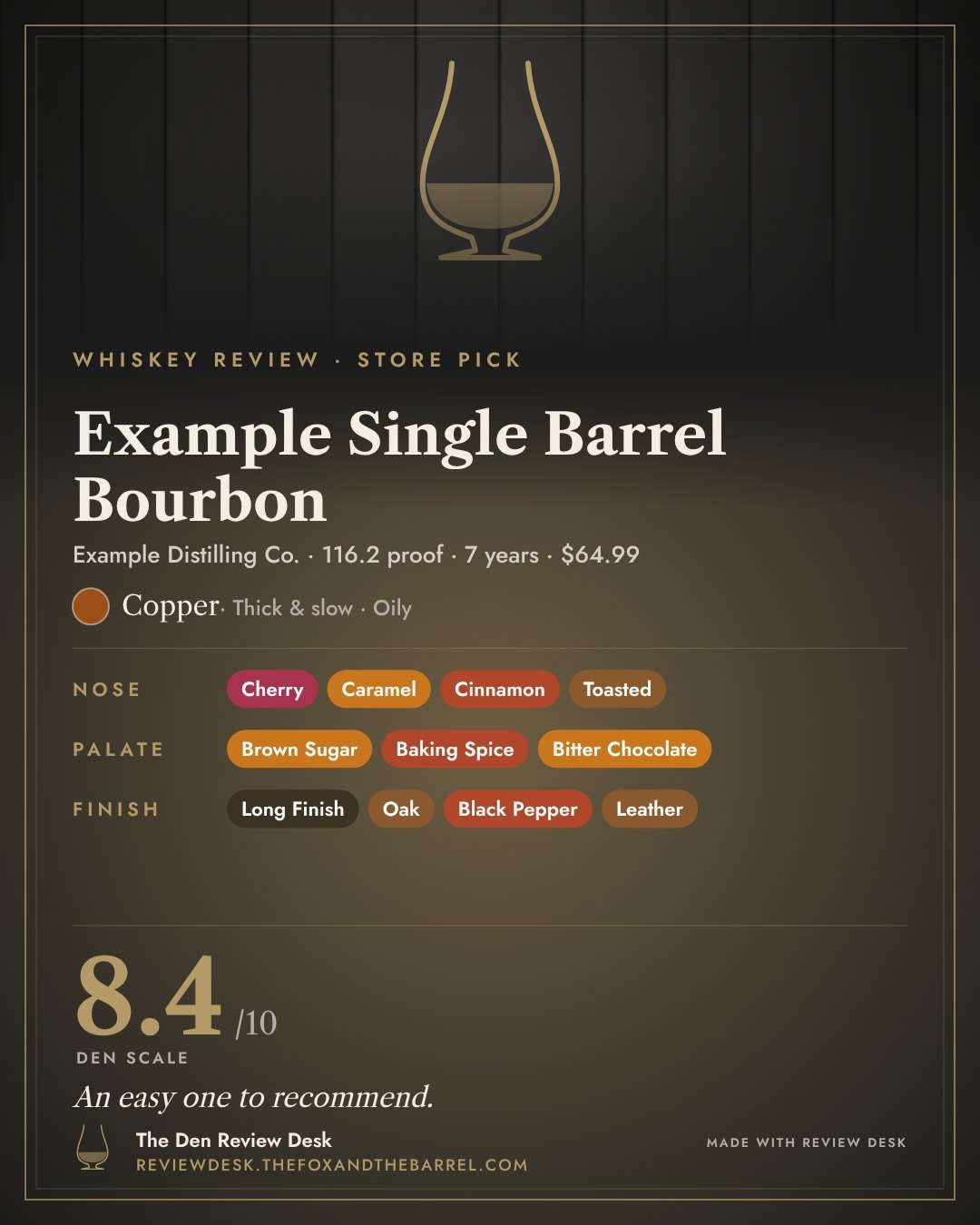
The Tasting card tab in the desk makes a 1080 × 1350 image, sized for an Instagram post, with your score, value call and every flavor you picked. Pick your colors before you download. For photo cards, the Card Studio has Showcase, The Hunt, Review and Post cards in four layouts.
The review file (.md)
Download the exampleSave .md keeps your review as a plain text Markdown file. The top block holds the details and your score; the sections below are your notes. Open it in any editor, post it to a blog, or load it back into the desk with Open .md file.
Show the example file
---
title: Example Single Barrel Bourbon
date: 2026-11-17
rating: 8.4
outof: 10
scale: Den Scale
distillery: Example Distilling Co.
style: Kentucky Straight Bourbon
age: 7 years
proof: 116.2
mashbill: 75% Corn, 13% Rye, 12% Barley
bottle: Open
pick: Store pick
price: 64.99
color: Copper
nose: Cherry, caramel, cinnamon, toasted oak
palate: Brown sugar, baking spice, dark chocolate
finish: Fresh oak, black pepper, leather
water: Cherry, mint
---

This is an example review. Load it to see how the desk works, then start a new review of your own.

## 👀 Visual

**Color:** Copper

Deep copper with a slow, oily coat on the glass.

## 👃 Nose

Cherry and caramel up front, with cinnamon and toasted oak once it sits.

## 👅 Palate

Brown sugar and baking spice, then dark chocolate. The proof shows up warm but never hot.

## 🔥 Finish

Long, with oak, black pepper and a little leather.

## 💧 With water

Three drops brought out more cherry and a little mint, and softened the oak.

---

## 💭 Thoughts

A barrel that drinks above its age and its price.

## ⭐ Rating: 8.4/10

Big flavor, well balanced, and easy to come back to.

**An easy one to recommend.**
Make a photo card in the Card Studio
- Pick a card. Showcase for a new bottle with its specs, The Hunt for one you tracked down, Review for your score and notes, and Post for anything else.
- Pick a layout. Classic puts the words over the photo, Split keeps the photo clear on top, Arch frames it in an arched window, and Spotlight shows the most photo.
- Fill it in. Use the review you're writing, open a review .md file, or type the details.
- Set the photo. Upload it, then slide and zoom until it sits right, and set how much shade goes behind the words.
- Pick the colors. One of the color themes, or your site's own.
- Save it. Download a 1080 × 1350 image sized for an Instagram post, and copy the caption it writes for you.
- Keep it for later. Save card file downloads everything on the card, photo included, as a small .json file. Open a card file puts it all back so you can change it and save again.
Post it to Discord
Sharing in a Discord channel, like a club's review channel? The desk formats it for you: headings, bold labels and the score line, split into messages under Discord's 2,000-character limit.
- Finish your review on the desk and open the Discord tab. Each message has its own Copy button.
- Save the card from the Tasting card tab so it's ready to attach.
- In your channel, start a new post with the name of the bottle as the title.
- Attach your photo first so it becomes the thumbnail, then the card.
- Paste message 1 and post it. Longer reviews come in more than one part; paste the rest as replies, in order.
On a phone? Copy one part at a time and paste it straight into the Discord app.
Learn from real reviews
Three reviews from this site, from a high score to a lower one. Notice how each one explains the score, not just states it.